The always-on tutor helping ease a nursing crisis
Elsevier's Sherpath AI is adding capacity to stretched nursing programs amid a growing workforce shortage
Almost every nurse now working in America started out the same way: in a classroom, being taught by someone who had too many students and too little time. Today the same constraint prevents many aspiring nurses from ever reaching that starting line.
In 2025, US nursing programs turned away roughly 93,000 qualified candidates. Even as schools expanded enrollment, demand continued to outpace capacity. In a system that has never lacked willing applicants, a key limitation is faculty time: how much instructors can devote to teaching, supporting students and managing programs.
Sherpath AI, Elsevier’s generative AI companion embedded within its digital nursing education courseware and drawn exclusively from Elsevier’s library of trusted, evidence-based content, was designed to ease exactly this kind of pressure. It gives students a curriculum-aligned resource available at any hour and helps faculty reclaim time for higher-value teaching and mentoring. This helps extend the support that institutions provide as they seek to serve more students, without simply adding to faculty workload.
At Arizona State University, home to a top-ranked nursing program, that promise is already being tested at scale. Since ASU began using Sherpath AI in August 2024, 1,100 students have asked it more than 55,000 questions, with usage spiking during exams and midterms. For Judy Karshmer, dean of ASU’s College of Nursing and Health Innovation, the value is not simply that students are using the tool, but that it gives them an additional layer of support in moments when faculty time is stretched. “Students want information immediately, in short bites. They want visuals, they want audio,” she says. “That's a heavy lift for faculty, so I think [Sherpath AI] is a great tool for them as well.”
An education bottleneck
The shortage that Sherpath AI is helping to ease spans the entire nursing curriculum, from classroom to hospital ward. Every nurse who cannot be trained today translates into longer waits, heavier workloads and fewer clinicians to meet rising demand.
The US faces a shortfall of registered nurses that is only expected to grow as the population ages, with the figure projected to stand at 8 percent by 2028. “An 8 percent registered nurse workforce shortage by 2028 means 270,000 workers short of anticipated demand,” points out Brent Gordon, president of healthcare education at Elsevier. The 93,000 suitable applicants turned away from programs in 2025 alone – a record number – would have narrowed that gap considerably. “These are qualified people who want to become nurses and can’t get in.”
A principal cause of the education bottleneck is a shortage of qualified instructors. According to the American Association of Colleges of Nursing (AACN), nursing faculty vacancy was running at 7.2 percent in 2025, with many schools struggling to replace retiring educators.
“The nursing educator workforce shortage often translates into increased teaching workloads for faculty,” Gordon notes, leading to demanding schedules and less time for individual student attention. “Sherpath AI helps support faculty productivity through course-preparation assistance and personalized student tutoring, 24/7.”
Among those reasons, AACN identifies a shortage of doctoral-prepared educators, difficulty finding candidates with the right specialty and teaching experience, and competition from higher-paying clinical roles.
Another pressure point is the student experience itself: academic burnout affects roughly one in five student nurses globally, threatening their ability to sustain the demands of training. Ashlee Prebble, a nursing student halfway through her Bachelor of Science in Nursing (BSN) at the Ascension Via Christi Wichita State University School of Nursing in Kansas, who also works in a hospital while she studies, describes the pressures that can lead to burnout plainly: “I have clinical [rotations], I have classes, I have exams, I still work at the hospital.”
With such a heavy workload, Prebble says an AI aid that makes studying more efficient creates a meaningful difference. “Being able to have things work so seamlessly together really saves a lot of time, when time is such a valuable part of my life,” she explains.
Ashlee before her first exam
Ashlee before her first exam
An AI companion can’t fix faculty vacancy or student burnout outright. What it can do is reclaim the one resource both problems consume: time.
Qualified applications turned away
In 2025, a total of 93,176 qualified applications (not applicants) were not accepted at schools of nursing nationwide. Source: AACN
Rate of decline
The primary barriers to accepting all qualified students at nursing schools are insufficient clinical placement sites, faculty, preceptors, and classroom space, as well as budget cuts.
AI built for the classroom
General-purpose AI tools were already part of nursing students’ study routines long before Sherpath AI arrived, for better and for worse. The trouble is accuracy: general-purpose models score as low as 50 to 60 percent on complex clinical questions, a margin that matters enormously when a wrong answer carries a high cost.
As a first-mover in the nursing space, Sherpath AI was designed around a narrower, stricter premise: answer only from trusted, Elsevier content and display links to the original sources.
"We tell the student or faculty exactly where the answers are coming from."
Every Sherpath AI answer carries a citation linking directly to the specific e-book section it was drawn from. Gordon calls the resulting content corpus the company’s core advantage. “The differentiator is our trusted content,” he notes. “We tell the student or faculty exactly where the answers are coming from. They can fact-check it, they can see it; it’s transparent and trustworthy. That’s really unique in the landscape.”
That trustworthiness is what drew Melissa Tirado, a third-semester nursing student at Utah’s Western Governors University completing an accelerated Bachelor of Science in Nursing, away from ChatGPT and toward Sherpath AI. “I wanted the answers to come straight from the textbook itself,” she explains. “With ChatGPT, they can use any source out there. But here, the answers are based on the specific textbook, whatever material Elsevier provides, and that’s what’s going to be on the test.” Lab reference ranges demonstrate why the distinction matters so much: values for interpreting test results can differ between facilities and textbooks, so a student revising for a specific exam needs the figures their own course uses. Anything sourced from elsewhere online could just as easily mislead them.
Students can also be confident that the manner in which an answer is delivered will suit their learning style. Answers can surface tutorial videos from the visual healthcare learning platform Osmosis, acquired by Elsevier in 2021, along with textbook illustrations, turning a text reply into something closer to a multimedia explanation for students who learn visually. “It personalizes the learning experience in a meaningful way,” says Gordon.
The tool’s positive impact is borne out in exam results. High-use students improved by an average of 400 points between their lowest and highest HESI Custom Exam scores, compared with 194 points among low-use students.
This effectiveness has won technology industry recognition too, with Sherpath AI named Best AI-Powered Tutoring Solution at the 2026 CODiE Awards.

Courtesy of ASU
Courtesy of ASU



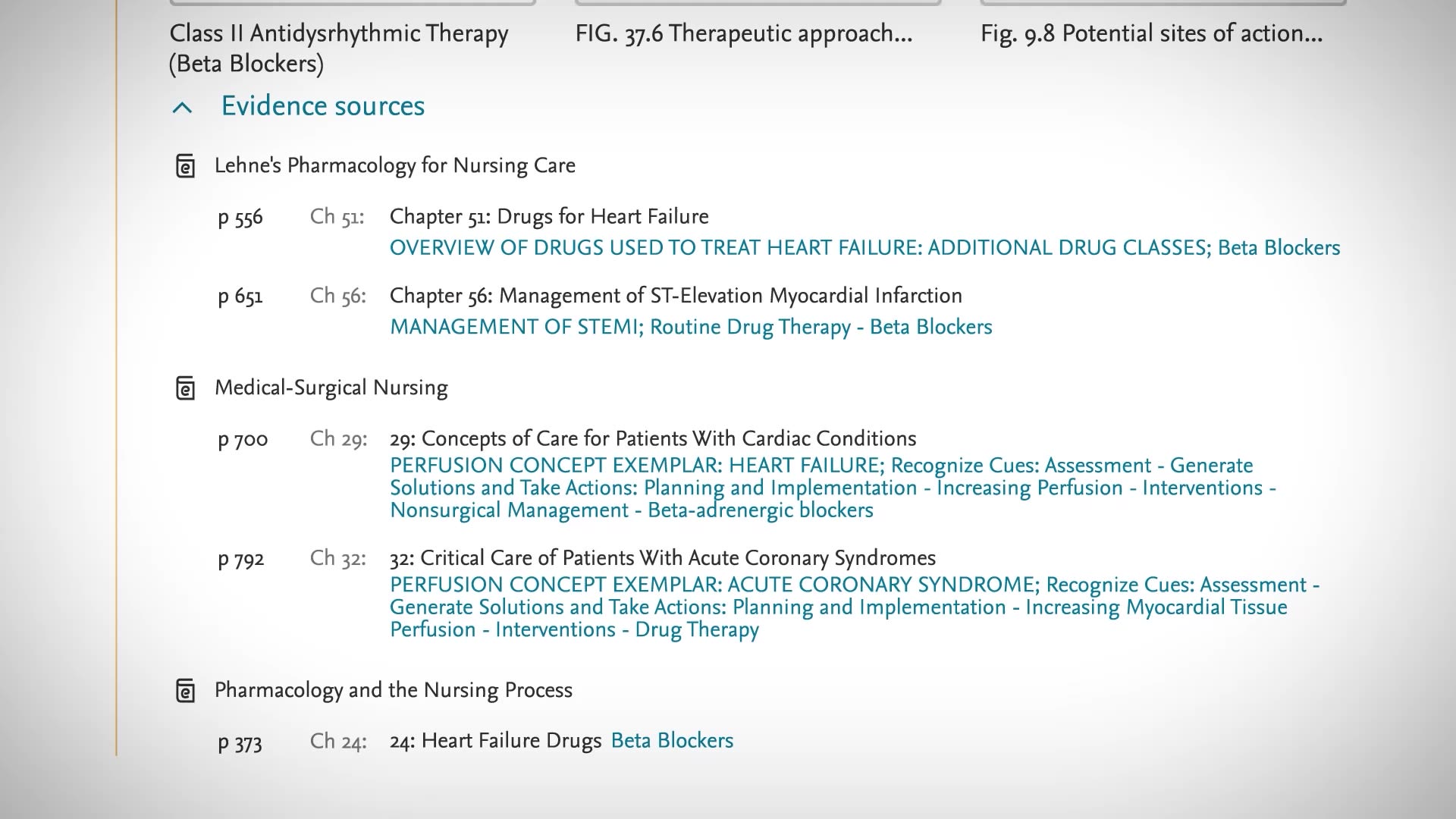

Sherpath AI taps into Elsevier's library of evidence-based, expert authored material developed with responsible AI principles in mind.
The answer, rationale and citations allow students to turn multi-chapter searches into a single answer.
Suggested prompts allow students to generate practice questions, clarify rationale or reinforce their understanding.
Students can jump straight to the exact page and paragraph directly from citations.
Sherpath AI helps instructors quickly create classroom activities, complete with a structured teaching plan and facilitation guide.
ASU students use Sherpath AI when the stakes are highest
1,100+
ASU students using Sherpath AI
55,000+
questions asked by ASU students
87%
chats involving multiple exchanges
High-use students saw an average 400-point improvement between their lowest and highest HESI Custom Exam scores, more than double the gains achieved by low-use students
Study companion, teaching aid
Sherpath AI takes on two primary roles: a study companion that supports students and a teaching aid that extends instructors’ capabilities.
Within each group, though, how people actually use Sherpath AI is entirely personal: no two study sessions or lesson preps look quite the same, reflecting the personalization that the solution was built to deliver.
For students, Sherpath AI removes friction from studying. For Wichita State student Prebble, for example, her AI companion eases a range of learning challenges, starting with turning scattered multi-chapter searches into a single answer – the same instinct behind Sherpath AI's flash cards, which allow students to generate cards on drug names, classifications and nursing considerations in a standardized format.
During finals week, she says, instead of chasing one fact “through billions of pages across all your books, now you can just ask ‘I’m looking for this information,’ and it tells you exactly where to find it, with a hyperlink.” When she wants to drill for the licensure exam, she can specify exactly the scenario she needs, such as “Generate 60 questions, not easy, no titles, on acid-base imbalances; focus specifically on the causes of respiratory alkalosis.”
“Whatever subject I'm studying, instead of going through the full notebook, I just go to the AI and ask. For example, right now I'm working on cystic fibrosis, so I asked 'What causes cystic fibrosis?' and it gave me a nice, short answer: it's caused by an autosomal recessive trait. Instead of doing a Control-F search through the textbook across five chapters."
This is fundamental to match the NCLEX’s specific style of testing. Sherpath AI also enables her to check her own learning progress instead of arranging office hours: being able to “gauge where I’m at without having to drive to campus and meet with a professor is such a help, especially when gas is $5 a gallon,” she explains. The same self-assistance extends beyond the classroom into her hospital shifts too, helping her look up whatever the curriculum hasn’t reached yet, such as “a type of drain you’ve never seen, or a condition you haven’t covered,” – things she says she’d “never have known otherwise until I asked.”
The need for that kind of always-on support is even more pronounced for students learning without the built-in community of a campus. Karshmer sees it clearest in ASU’s “Learn Where You Live” initiative, which teaches small cohorts scattered across rural Arizona entirely remotely: “Those students are going to be desperate to have a study buddy,” she observes. “They don’t have the depth of a group of people saying, ‘let’s all study together.’”
For faculty, Sherpath AI offers a shoulder to lean on for their teaching, supporting course preparation and handling routine questions at scale.
Dr. Judy Karshmer
Dr. Judy Karshmer
One instructor uses it to build new exam questions, generating wrong-answer options and explanations for each answer – work that would otherwise take a weekend to draft by hand. Another, a first-year instructor teaching a subject she had not touched since her own training, uses it live in class as a confidence check on details she wants to verify.
Beyond improving existing workflows, Sherpath AI enables an entirely new level of personalization in the classroom itself. One instructor opens class by running a question through Sherpath AI on the spot, then asks students to compare the response against the lecture slides, refining the prompt for context such as adult versus pediatric care. Every instructor can check “Instructor Insights” – a dashboard allowing them to see the questions students are asking on their own – and use those patterns to shape exam reviews around the topics where students are struggling most, giving their class the support proactively instead of waiting until test results reveal gaps.
The reclaimed faculty time these new capabilities unlock can be redirected toward the capacity the profession is short on: mentoring, higher-order teaching and the sustained attention that helps instructors support more students effectively. At an institutional level, this creates a pathway for programs to grow enrollment while maintaining or improving quality, without increasing faculty hours in direct proportion to student numbers.
Ever-growing engagement
ASU’s Karshmer says Sherpath AI found its place at ASU when it became part of students’ assignments, faculty had opportunities to learn and discuss the ethical use of AI, and the university treated adoption as an ongoing process rather than a single launch. “It’s not a one-and-done,” she emphasizes. “The sophistication of using a tool like Sherpath is really a commitment to ongoing work and ongoing training, and most people only ever use a very small fraction of what it can do.”
What makes ASU’s adoption exemplary isn’t just the number of students using Sherpath AI, but how far each of them takes it. Most sessions go beyond a single question and answer: well over half involve five or more exchanges, indicating students working a topic through rather than looking up something once and leaving. The longest single conversation ran to nearly 1,500 exchanges, closer to a semester-long study partner than a search bar.
For Gordon, that type of usage points toward where the product goes next. “Very soon, Sherpath AI won’t just answer questions; it’ll interact with the student the way a real tutor would,” he explains. “That two-way conversation is a really powerful new dimension.” For a profession short of time and people, that ambition is worth watching closely.