What if the next life-saving drug is buried in a patent diagram?



In early drug discovery, progress can hinge on a single decision. Researchers must choose whether to pursue a biological target, knowing the wrong path can cost years and the right one may never surface again.
The evidence exists. But some of the most valuable insights are often invisible to conventional search.

In early drug discovery, progress can hinge on a single decision. Researchers must choose whether to pursue a biological target, knowing the wrong path can cost years and the right one may never surface again.
The evidence exists. But some of the most valuable insights are often invisible to conventional search.

When that chemistry is unmasked,
new possibilities are opened.


What happens when evidence slows discovery ?

This is a familiar situation for teams at Sygnature Discovery.
Sygnature works with pharmaceutical and biotech partners early in discovery programs. Their work spans areas from oncology and immunology to neuroscience and metabolic disorders.
In one project with a U.S. biotech, scientists were asked to narrow a long list of biological targets to just five, evaluating novelty, disease linkage, safety signals and competitive risk.
The limiting factor wasn’t expertise. It was access to evidence, at scale.
Data was spread across journals and patents. Patents, especially, were dense, inconsistently indexed and often untranslated.
Traditionally, assembling the information would take weeks. But the team did something differently.

Better information, faster decisions

What changed was how the evidence was connected, unified and supported.
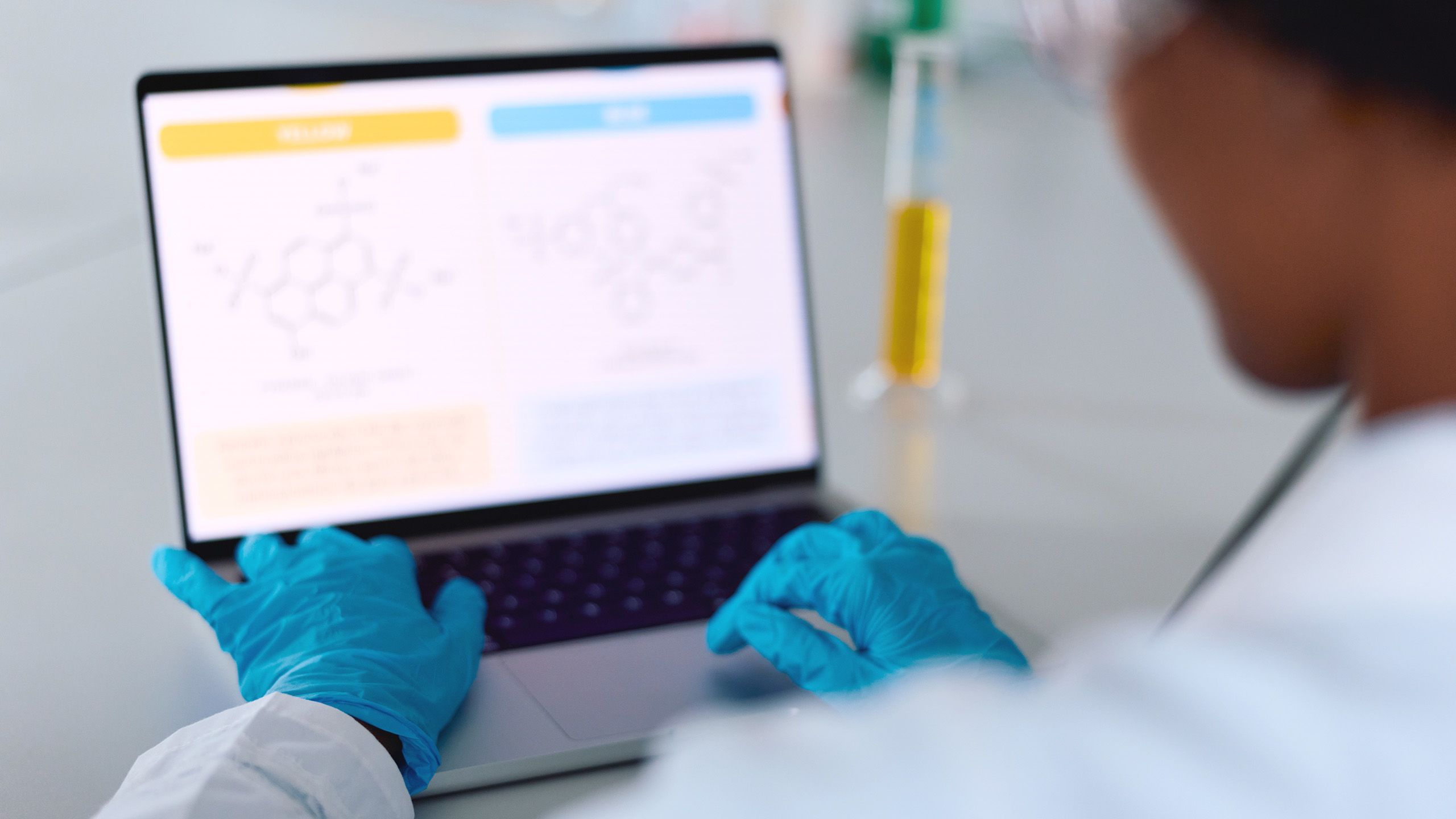
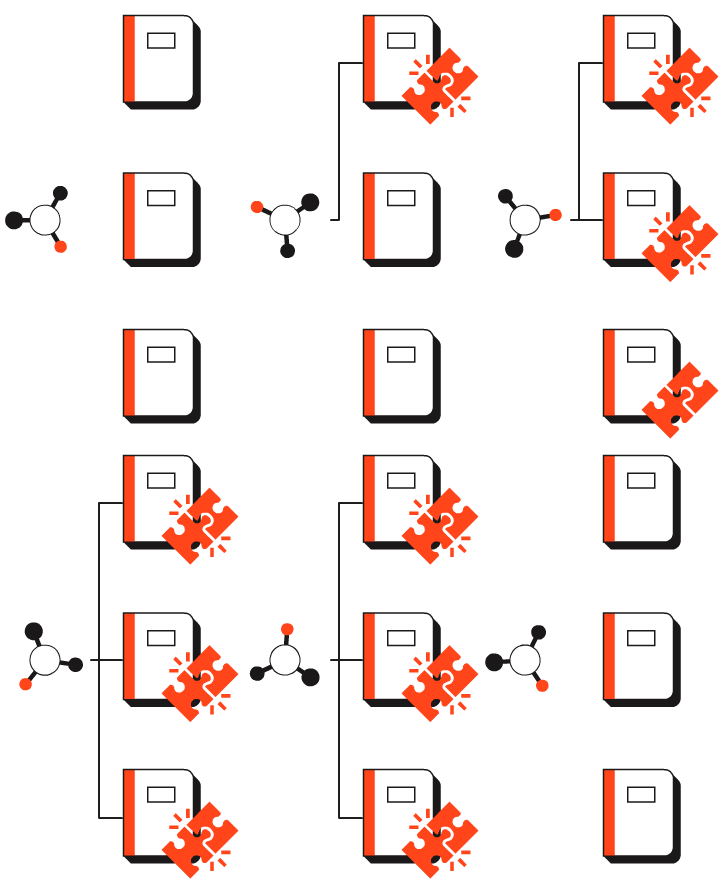
By embedding Reaxys, Elsevier’s chemistry intelligence platform, into AI-supported workflows, teams could bring chemical, bioactivity and patent evidence together, all traceable back to the source.
Researchers could start with the structure of a molecule and quickly see where it had been studied before, in papers, in patents, and in related compounds. Built-in translation and indexing reduced the risk of missing something important.
The process took days instead of weeks. Decisions were made with context, not guesswork.
The result was shared clarity — early enough to change the trajectory of a program.
But even with literature and patents connected, another blind spot remained.

“Reaxys automates bringing data together so our scientists can focus on analysis and making more confident decisions.”
— Colin Sambrook Smith, Director of Computational Sciences and Informatics, Sygnature Discovery


Now scale that problem globally


The same clarity problem shows up in drug repurposing. There are thousands of approved drugs. There are thousands of diseases.
Could an existing drug work somewhere new?
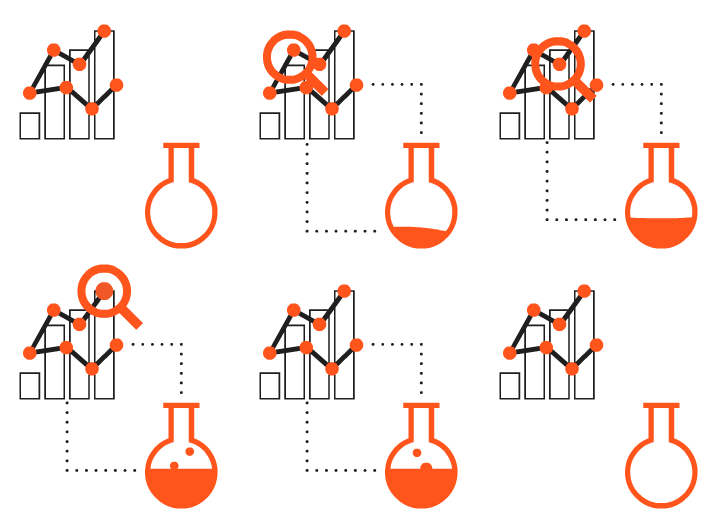
In many cases, the evidence is already buried in the literature. What hasn’t been possible — until recently — is examining all those connections at scale.
Organizations like Every Cure use AI to do exactly that, supported by data provided by Elsevier. They score tens of millions of drug–disease combinations in hours instead of months.


In one documented case, the platform surfaced adalimumab — a TNF inhibitor usually prescribed for rheumatoid arthritis — as the top-ranked option for a patient with idiopathic multicentric Castleman’s disease, a rare immune disorder that can cause organ failure.
He was being transferred to hospice care after existing treatments had failed. Doctors prescribed adalimumab.
His organ function improved. His symptoms subsided. Nearly two years later, he remains in remission.
The breakthrough isn’t speed alone. AI can only surface meaningful candidates when it is grounded in structured, trusted scientific knowledge, evidence researchers can trace and validate.


What becomes possible next
The future of drug discovery will bring new insights and technologies.
But some of the most important progress may come from clearer sightlines across what we already know — and the ability to explore that knowledge confidently and at scale.
Elsevier supports this shift by enabling the exchange and reuse of trusted scientific knowledge through journals, data foundations, and platforms like Reaxys. When AI is grounded in rigorous, peer-reviewed science, discovery doesn’t just move faster, it helps improve outcomes for all.




What becomes possible next
The future of drug discovery will bring new insights and technologies.
But some of the most important progress may come from clearer sightlines across what we already know — and the ability to explore that knowledge confidently and at scale.
Elsevier supports this shift by enabling the exchange and reuse of trusted scientific knowledge through journals, data foundations, and platforms like Reaxys. When AI is grounded in rigorous, peer-reviewed science, discovery doesn’t just move faster, it helps improve outcomes for all.